

Bob Marley Unpublished
Roger Steffens’ Exclusive, Unseen Marley Portraits
Written By: ROB HILL
“Welcome beautiful souls… I hope you like jammin’ too,” says Roger Steffens, or as Bob Marley nicknamed him, “Ras RoJah.” His silky baritone voice is friendly, authoritative, and welcoming. Dressed in a reggae tie-dye T-shirt, shorts, and Rasta socks, he has the amiable air of your favorite professor. At 83 years old, he’s full of energy, wit, and has a thick head of gray hair—a master storyteller with a photographic memory.
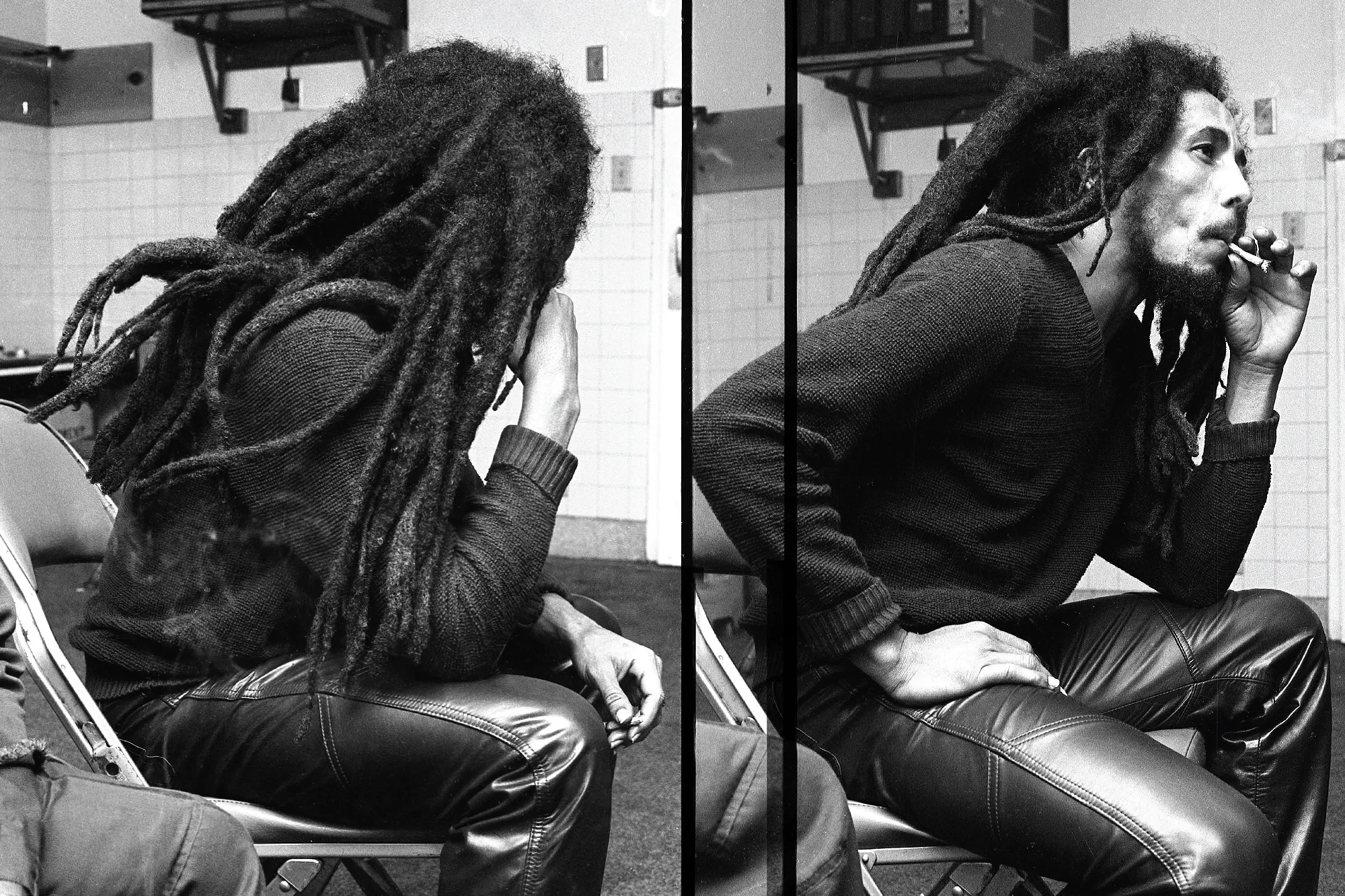
Ras has invited Hiii to his home in Echo Park to view his “Reggae Ark-Hives”—the largest collection of reggae and Bob Marley artifacts and memorabilia in the world. We head downstairs to the basement, a seven-room, meticulously archived shrine of all things Marley and reggae. Each room is stuffed to the ceiling with 30,000 photos, 2,000 hours of video, 14,000 hours of cassette tapes, 10,000 records/CDs, 30,000 fliers, 3,000 books/magazines, 2,000 posters, 1,500 t-shirts, 1,000 stickers, 3,000 buttons, and 1,000 business cards (including Marley’s from the ‘70s). Plus, hundreds of paintings, statues, promotional materials, clothing, banners, backstage passes, stamps, and smoking materials. He reaches into a drawer and pulls out a black folder. Inside: dozens of never-seen pictures of Bob Marley he took in 1979. “You can run these,” he says with a beatific smile. (Both pictured on the previous page.)
“Oh, and let’s not forget to go to the garage,” he says like a trained tenor. “It’s a virtual morgue of thousands of back issues of The Beat magazine, the reggae magazine that I founded.” A virtual who’s who of reggae fanatics have toured this archive: Keith Richards filmed a documentary there (he had a rider of things that had to be in the house, including a bottle of Stoli, a six-pack of beer, a pack of Marlboros, some rolling papers, and an ashtray), Carlos Santana, Leonardo DiCaprio, Oliver Stone, Rod Stewart, Laura Dern, Ben Harper, and most of Bob Marley’s kids. Their photos smiling with Steffens are pasted everywhere.
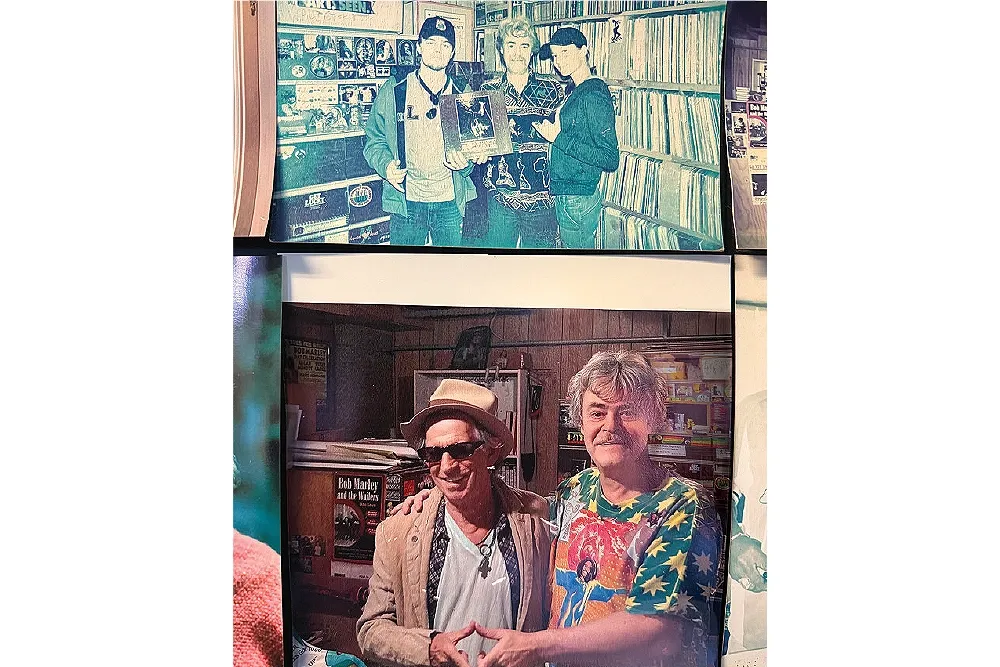
Top: Leonardo DiCaprio and Gisele Bündchen with Steffens in the Ark-Hives Room. Bottom: The Rolling Stones’ Keith Richards and Steffens in the Ark-Hives Room.
This gargantuan collection is for sale. It’s been valued at two million dollars. He’s had a handful of offers, the latest from a man in 2018 who wasn’t able to secure a lease in Montego Bay, Jamaica, to build the museum to house it. It was, however, an ironic stroke of good fortune, as if the angel of Bob was looking out for the collection.
“The amphitheater adjacent to the site was completely obliterated in the devastating hurricane,” Steffens says. “All this,” he waves his hand, “would be... gone!”
You’ll soon be hearing Steffens’ silken voice again on KCRW’s website; they will begin rebroadcasting his entire “Reggae Beat” run of 395 programs on the KCRW app and streaming channels, including Vintage24.
Roger Steffens is a true Renaissance man—archivist, photographer, historian, actor, poet, humorist, author, DJ, speaker, storyteller, music executive, and narrator. With his razor-sharp wit, shaggy gray hair and mustache, and a twinkle in his eye, he’s a sorta modern-day, maverick-hippie version of Mark Twain—trading cigars and whiskey for joints and LSD.
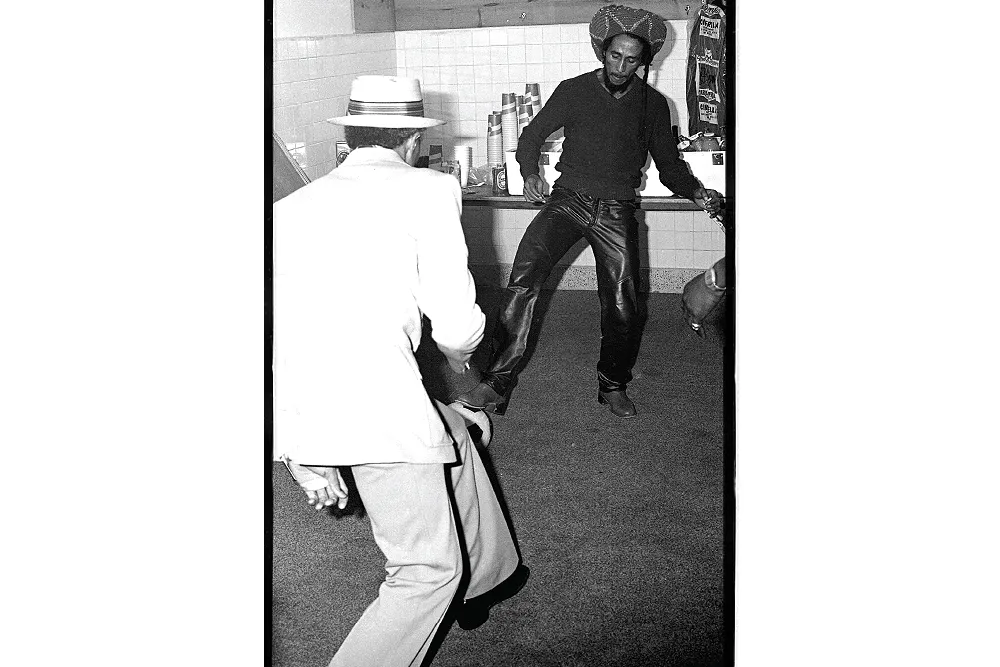
Steffens was given his first hit of LSD in 1966 by a friend. At the time, he’d never even smoked a joint. Psychedelics “changed everything.”
Steffens was given his first hit of LSDin 1966 by a friend. At the time, he’d never even smoked a joint. Psychedelics “changed everything,” giving him the idea of “alternative living.”
His use of cannabis has been steady since 1967.
“I have smoked herb pretty much every day since then,” Steffens says. “If I meet someone who smokes, I know instantly that he or she is going to have a whole lot in common with me, and it proves to me that a stranger is just a friend you haven’t met yet. Folks who dealt weed in the pre-legal days could be powerful connections to others who shared the joy of consumption and open up many new areas of interest that sometimes could be life changing in very positive ways.”
Cannabis paved the path to reggae music, and set Bob Marley’s soul ablaze.
“I realized very early on ... that (Marley) was going to be one of the most important singers in the world. He was the one that broke through and took reggae music global.”
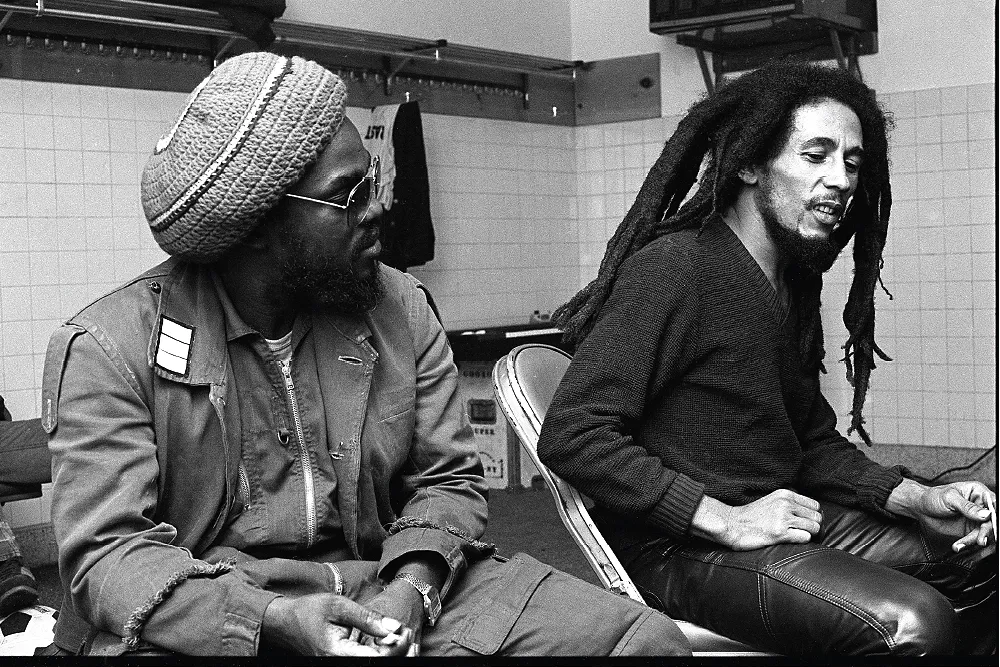
Above: Family Man with Bob.
CHAPTER 1: REGGAE, TOKING WITH BOB & THE $75,000 POSTER
How did you come to host a Bob Marley show on the radio?
In 1973, through the Wailers’ first American release, Catch A Fire. Mary, my wife, and I went to Jamaica in the summer of 1976 to find all the rare records I’d been reading about in the British musical press, and in our first moments in Kingston, during a national state of emergency, I had my pocket picked by one of the bigger local stars of reggae at the time. Eventually, a friendly stranger took us to Jimmy Cliff’s house, where we met a bunch of the major players of the time. Then, three years after moving to LA in 1975, I met Hank Holmes, who had amassed a collection of over 8,000 reggae recordings. I figured with his knowledge and records, coupled with my broadcasting background, we could do a great reggae show in a city where surprisingly none yet existed. KCRW gave us a two-hour show on Sunday afternoons. During our first annual fund drive we raised in three hours what the entire previous ten-day drive had raised, and our time was doubled to four hours every Sunday. By the early ‘80s we were the most popular non-commercial radio program in LA. Bob Marley was our first guest.
What was it about Bob, specifically, that set your soul on fire?
I have always been involved with poetry, and it was Bob’s words that first hit me, followed by the hypnotic power of his heart-beat reggae rhythms. By the early ‘70s, when the major corporations had eaten up most of the independent labels and popular music had turned away from its folk-influenced, politically involved messages to disco drivel, aging hippies like me wanted something that reignited their fervor, especially if it had the harmonic echoes of doo-wop music from the earliest days of the rock ‘n’ roll revolution. That, I recognized instantly in reggae. And from that point on, anyone who came to my house was introduced to the Wailers and other prophets and prognosticators of a love-led future.
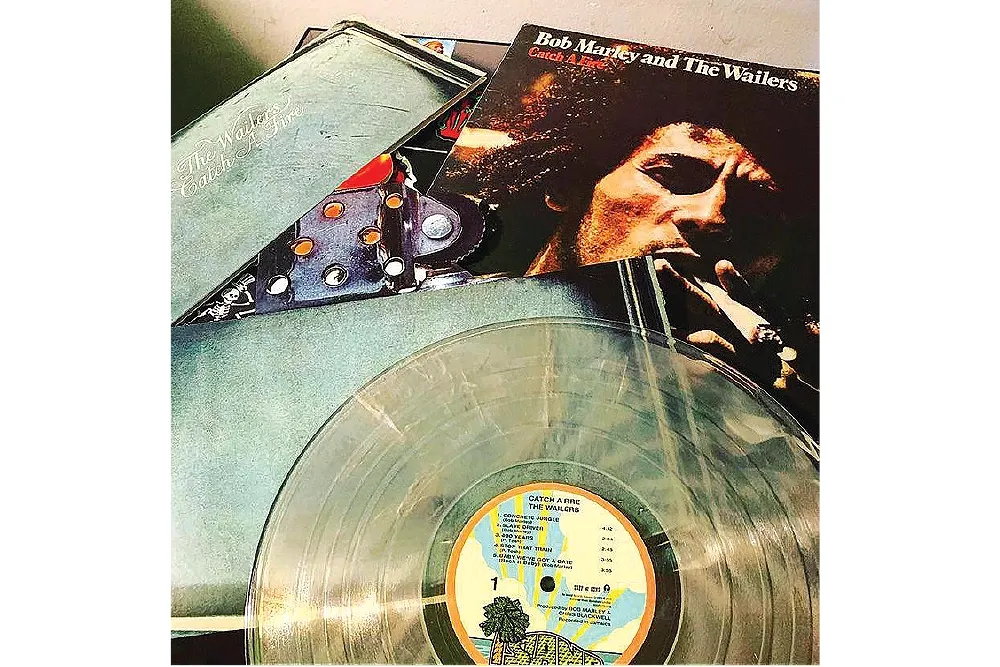
Above: Catch a Fire was released in 1973 by Bob Marley & the Wailers.
When did you first meet Bob Marley?
It was in the summer of 1978 and he was playing in Santa Cruz. Inside, it was like a high school gym with bleachers on three sides, a low stage and a soundboard in the middle of the dance floor. Standing by it was a tall man with little dreads sprouting. I asked him if they were going to perform the song “Waiting in Vain” that night. “Why?” he asked. “That’s my favorite Marley song, especially that incredible lead guitar that Junior Marvin plays.” “Do you want to meet Bob?” he responded. “Yeah!” I answered excitedly. He led me down along corridor to get backstage, asking, “What’s your name?” I told him and he said, “Hi, I’m Junior Marvin.”
Entering the large room, we found a very quiet collection of near zombie-fied band members seated around a long set of connected tables. Each had a small mound of herb in front of them, with a lighter, rolling papers, and an ashtray, and no one was saying anything to anyone. I had a poster that someone had been passing out to people as they waited in line, promoting a show a few days later at the Greek Theater in Berkeley. Junior said, “Why don’t you ask Bob to sign that?” Bob and the whole band signed the poster. It’s likely the only of its kind.
You took the most famous photo of Bob in 1979, backstage in San Diego wearing leather pants and smoking a J. Tell us about this session?
Those shots were taken on November 24, 1979. Hank Holmes and I had just started the KCRW show the previous month. Island Records’ publicist called and asked if we would “mind going on the road with Bob” during his stay in Southern California. Bob was in poor health during this time, two and a half years into his battle with cancer, and had mostly ceased doing one-on-one interviews. So before the show in San Diego, he had a press conference with about twenty people behind the bleachers in the Sports Arena. I began snapping away and got the famous one—the profile of him smoking and smiling. It has been bootlegged all over the world, on T-shirts, album covers, posters, fliers, even tattoos. One of my greatest joys was finding its use on the Soul Almighty album poster hanging over Bob’s mixing board at Tuff Gong in 2001.
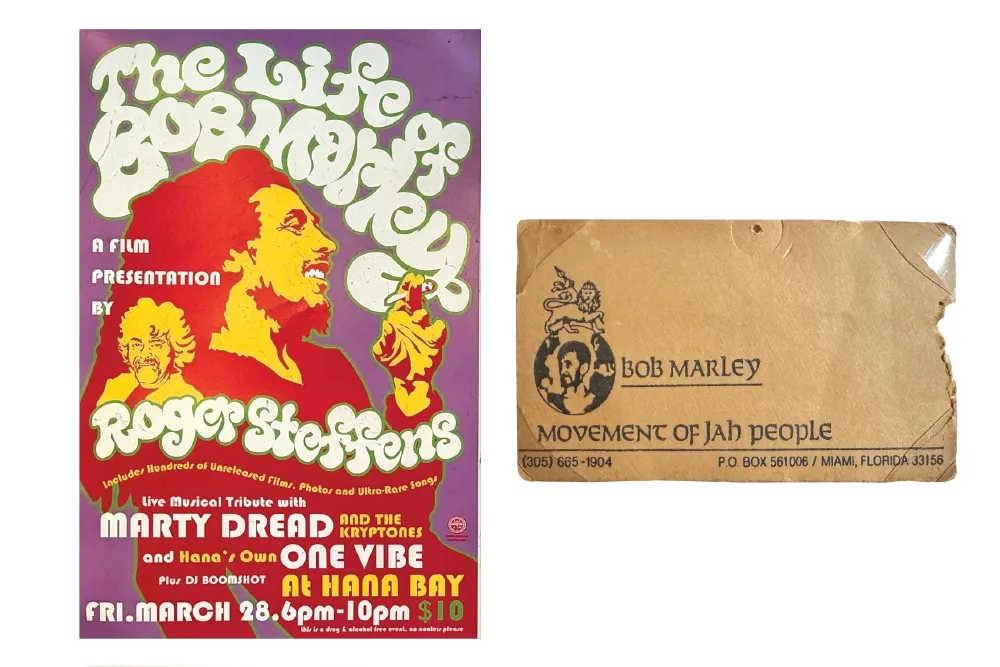
Left: Poster for Steffens’ documentary about Marley, The Life of Bob Marley. Right: Bob Marley’s business card from the ’70s.
What was a Bob Marley concert like?
Mary and I first saw him at the Oakland Paramount in July of 1975, shortly after she and I met on a mass acid trip in a pygmy forest in Mendocino under a total eclipse of the moon. We got married ten days later; she shared my love of the Wailers’ music. We sat in the first row of the balcony and when Bob took the stage there were gasps from the audience. His budding locks just reached his shoulders, and he moved like a marionette whose strings had gotten twisted, a herky-jerky dance of trancelike magnetism like no one we’d ever witnessed before. The next time we saw him was at the Burbank Starlight Amphitheater, the night that Peter Tosh, his former bandmate, joined him onstage for the encore of “Get Up, Stand Up” which they had co-written. It was the only time after the breakup of the Wailers that they ever appeared together. It seemed that Bob was unaware that Peter was in attendance. When Bob greeted him he had the biggest smile on his face.
What kind of cannabis did Bob smoke?
Bob was known to drive the length of Jamaica if he heard of a new strain. Bunny Wailer told me that one of Bob’s favorites was Lamb’s Bread, aka Lamb’s Breath. He gave us some and we were knocked out by it. Early the following morning at customs the inspector took one look at my extremely stoned friend and took him into a back room... and strip searched him!
How did Bob move the cannabis from concert to concert without getting busted? He must have been a law enforcement target by then.
Bob had huge speakers that were hollowed out, and at each stop they were the first things to be offloaded, with the band eagerly gathering around. And don’t forget, the major pot growers and dealers were always allowed into the inner circles at every stop on the tours. Everyone wanted to be able to say, “Bob Marley smoked my herb!”
“Bob was known to drive the length of Jamaica if he heard of a new strain. Bunny Wailer told me that one of Bob’s favorites was Lamb’s Bread, aka Lamb’s Breath.”
- Steffens
What was it like to toke with Bob?
Bob was insistent that herb was not just for “jollification,” but, more importantly, for “headucation”—it helped you see beyond the curtain of consensus reality and created unity and wonder. He didn’t pass his spliff as Yanks do, but he made sure that everyone who wanted to share his stash got to help themselves. He appeared to enjoy getting deeply high before a show, like the time we first met backstage in Santa Cruz in the summer of ‘78. He appeared semi-comatose, yet went on to enrapture his audience.
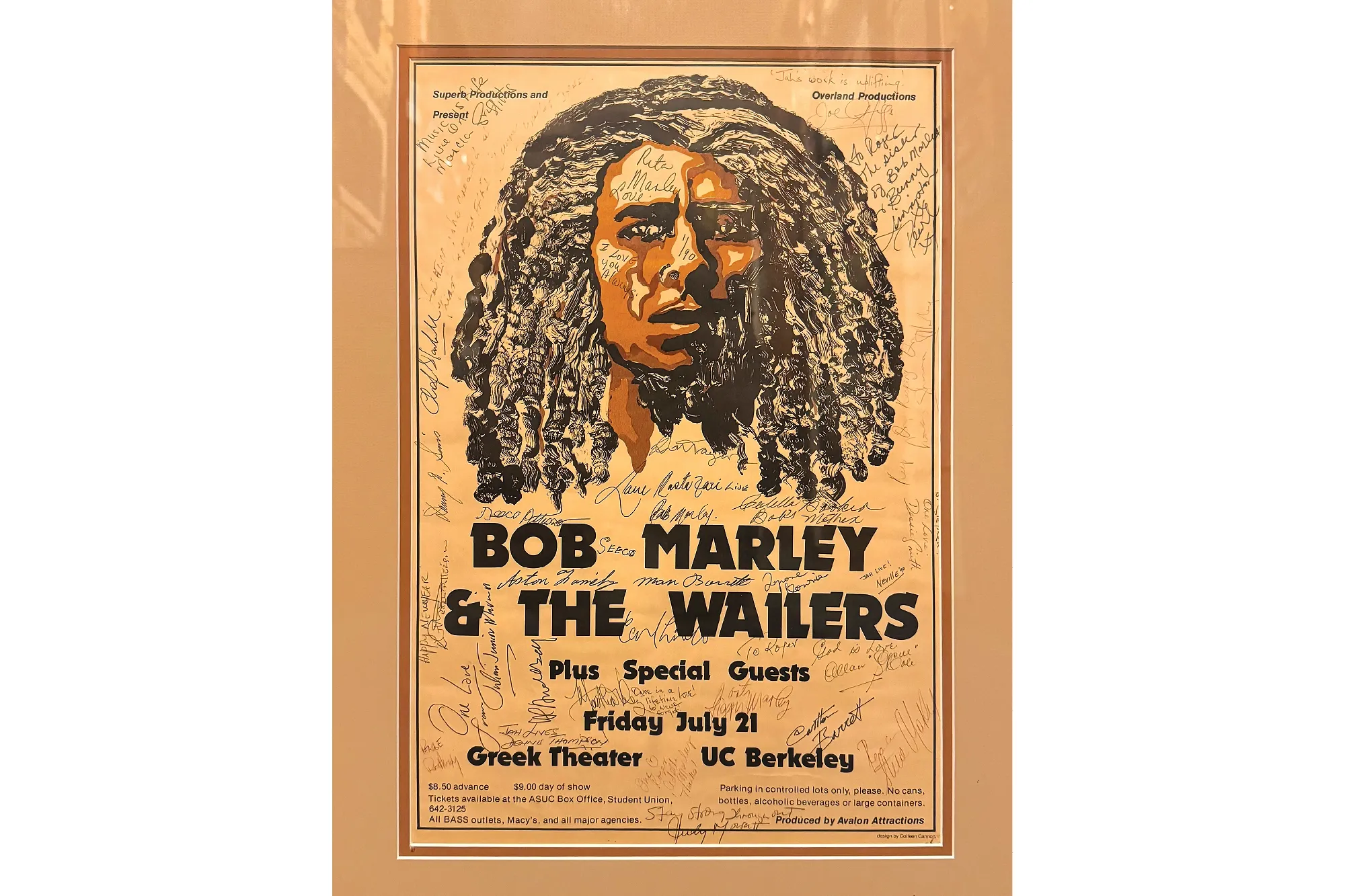
Above: The famous $75K poster that all members of the Wailers signed for Steffens.
What do you think Bob would think of cannabis now being sold legally in dispensaries?
I’m certain he would have become one of the first legitimate sellers with his own brand. I know several of his children have become professionally involved.
Of your thousands of Marley memorabilia do you have a favorite?
The Santa Cruz poster, which has now been signed by the entire band. When I loaned it to the Grammy Museum years ago, they insured it for $75,000.
You finally showed your Marley collection to the world in 2001.
Yes, I did an eight-month-long exhibit of my archives at the Queen Mary, attended by thousands of people. Over the years, I’ve written eight books about Bob Marley and the history of reggae. Two were award winners.
If Bob were alive today, what do you think he'd be doing?
I think he would be living in Selassieville, the village in Africa that he founded for repatriating Rastas. His touring would have stopped, except for very special appearances, such as performing at Obama’s first inauguration.
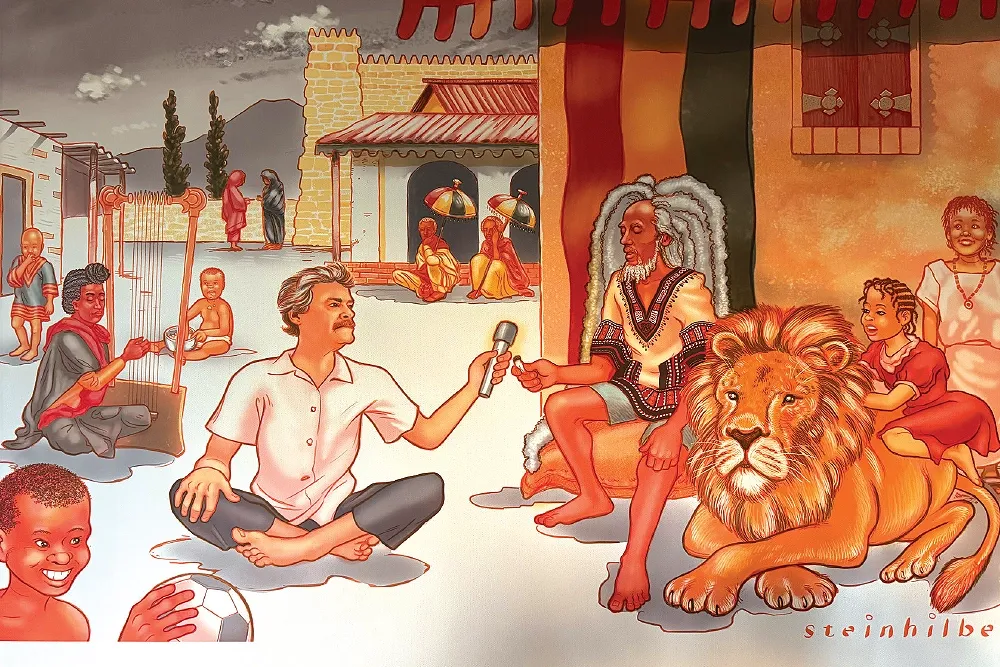
Above: Painting by Robert Steinhilber.
CHAPTER 2: VIETNAM, THE COCONUT MONK & COMMIE WEED
Before your great career, you were in a psychological warfare unit in Vietnam. What did that entail? I have a feeling that experience helped form the person you are today. What did you find?
I got drafted in May of 1967. I went to the local recruiting board to see how I could avoid going to Nam, and they told me that with my broadcasting background I could enlist for an extra year, and they would send me to the Defense Information School to learn Psychological Operations (PsyOps).
My orders were to go to Vietnam and carry 80 pounds of loudspeaker backpacks into frontline combat, broadcasting pre-recorded surrender messages to the Viet Cong. One of the most ludicrous missions I was sent on was near Pleiku in the Central Highlands, where I crewed several times on a small O-2B push-pull plane that had a hole cut in the bottom of its fuselage. I dropped Vietnamese-language propaganda leaflets on straw-hutted Montagnard settlements filled with illiterate natives. I was at Hue (where Stanley Kubrick’s Full Metal Jacket movie was set) the week the communist troops were driven out. I also worked in the Mekong Delta, on the island of the Coconut Monk.
“My orders were to go to Vietnam and carry 80 pounds of loudspeaker backpacks into frontline combat, broadcasting pre-recorded surrender messages to the Viet Cong.”
- Steffens
The Coconut Monk?
Johnny Steinbeck, son of the Nobel Prize-winning novelist, served in the Army and was busted for smoking herb. He testified about that in Congress and returned as a civilian to Vietnam to be the liaison between the American Embassy and a tiny four-and-a-half-foot tall man known as the Coconut Monk, who had lived in a palm tree for 20 years fasting and praying for peace. In the early ‘60s a Chinese benefactor gave him a long sandbar island in the middle of the Mekong Delta. The VC held the south bank of the river, and the American and South Vietnam armies had shifted control of the north bank. They blasted rockets and mortars over the island but almost never attacked the actual community of several thousand deserters from both sides of the war who had flocked to the island. It was a religious Disneyland, with a circular prayer platform at the tip of the island where, every three hours, day and night, each family in the community would send a representative to pray for peace.
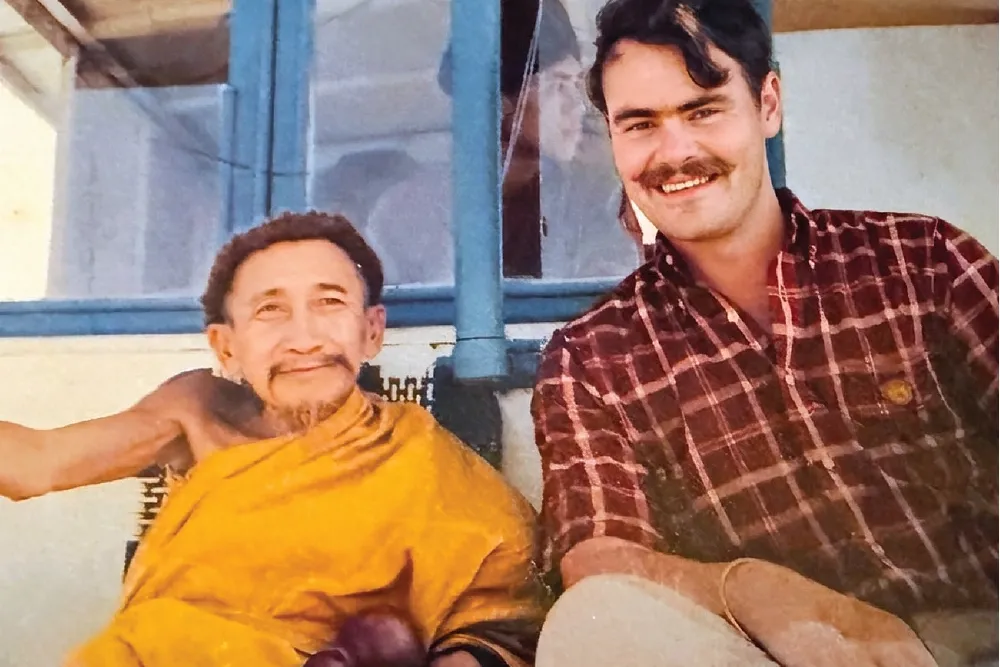
Above: Steffens with the Coconut Monk in Vietnam, photo by John Steinbeck IV.
Johnny Steinbeck partook—were a lot of soldiers smoking cannabis?
When I got to Nam in early November 1967 perhaps ten percent of my fellow enlisted men smoked. Two years later it was closer to 70% with all the hippies who’d been drafted. You could get it anywhere in the country with ease. For the guys out in the field, the maids in their bases would leave it under their pillows, usually in packs that looked like ordinary cigarettes. Chief among these, available in packs of 20, were Park Lanes, 25 cents a pack. You could get a carton of 200 for two bucks U.S., a penny a joint, from your local cyclo driver.
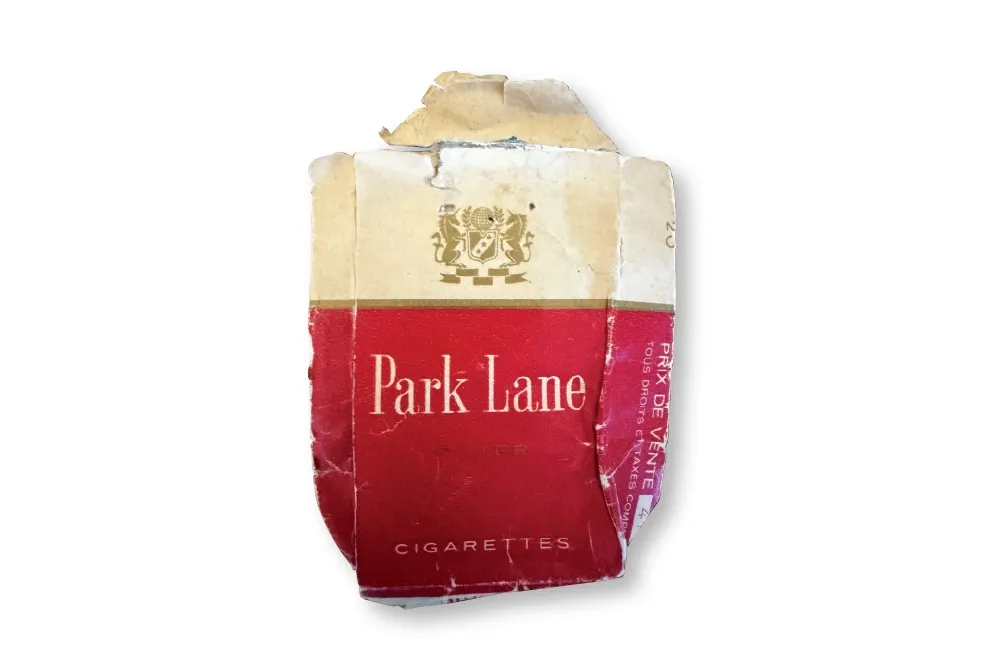
Above: An empty pack of Park Lane cigarettes, which were filled with cannabis joints and sold to soldiers in Vietnam for 25 cents a pack.
CHAPTER 3: JIM MORRISON’S DEATH, RON KOVIC & THE BORN ON THE 4TH OF JULY SAGA
After your stint in Vietnam you moved to Morocco. There, you ran into the mysterious “Count” who the previous night in Paris had broken down The Doors’ singer Jim Morrison’s bathroom door and found him dead—most likely from the strong heroin he sold him.
Yes, on July 5th a courier arrived at our house with an invitation to dinner to meet the handsome Jean “The Count” De Breteuil, a French aristocrat. His family owned all French-language newspapers in North Africa. He was mostly a playboy and a top-rank drug dealer to the stars. He had just arrived from Paris with Marianne Faithfull, Keith Richards’ and Mick Jagger’s ex-girlfriend. He was also having an affair with and supplying heroin to Morrison’s girlfriend Pamela Courson. At dinner they appeared ripped out of their skulls, and afterwards they brought us up to the top of the palace’s tower, where Winston Churchill had painted some of his most famous canvases. There, Jean explained how Courson had called him in a panic and asked him to come over to their apartment where the bathroom door was locked with Morrison inside. They broke down the door and discovered Morrison’s dead body in the bathtub. I doubted their story as there were no reports anywhere that Morrison had died, until the following Thursday when the news broke.
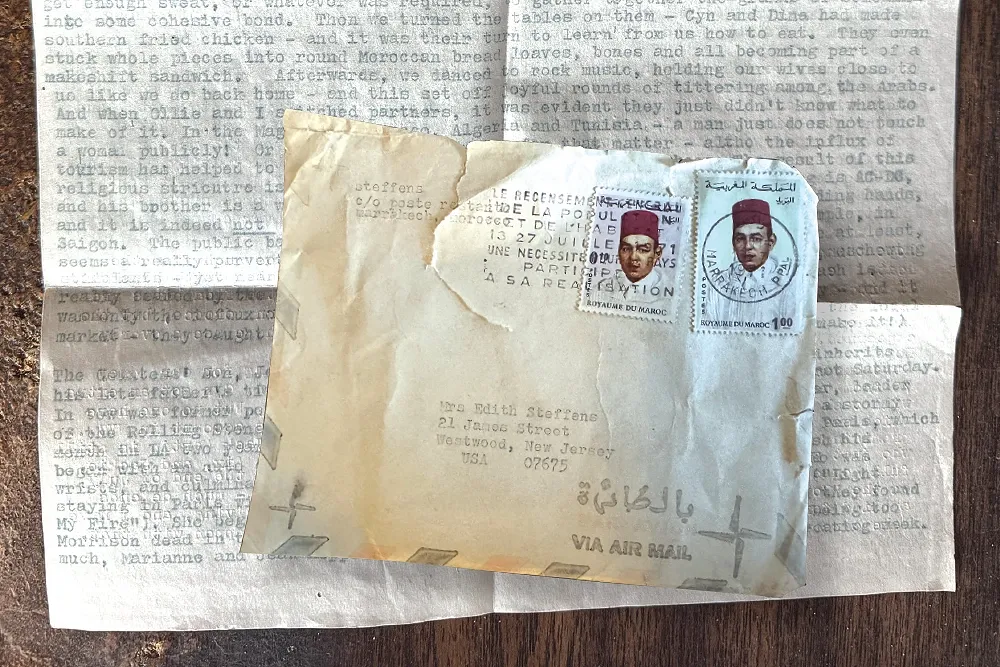
Above: A letter Steffens wrote to his mother in 1971 from Morocco, telling her Jim Morrison of The Doors had died in Paris—a week before the press reported it.
You helped Ron Kovic write and sell his book, Born on the Fourth of July, which Oliver Stone made into a movie starring Tom Cruise as Ron. It won all kinds of awards in 1990. What was Ron like?
Yes, handicapped Vietnam vet Ron Kovic and I became friends in 1973, when war correspondent Richard Boyle, subject of Oliver Stone’s film Salvador, brought Kovic over to my apartment in Berkeley. In December of that year, I visited Ron in his small apartment on the beach in Venice, CA. He showed me a stack of paper with typing that went from the very edges top to bottom. He then wheeled his chair over to the fire. “What’s that?” I asked. “Ah,” he sighed, “It’s a lot of shit I wrote to get it off my mind.” He then threw it into the fireplace. I quickly grabbed it and said, “Let me see that before you destroy it!”
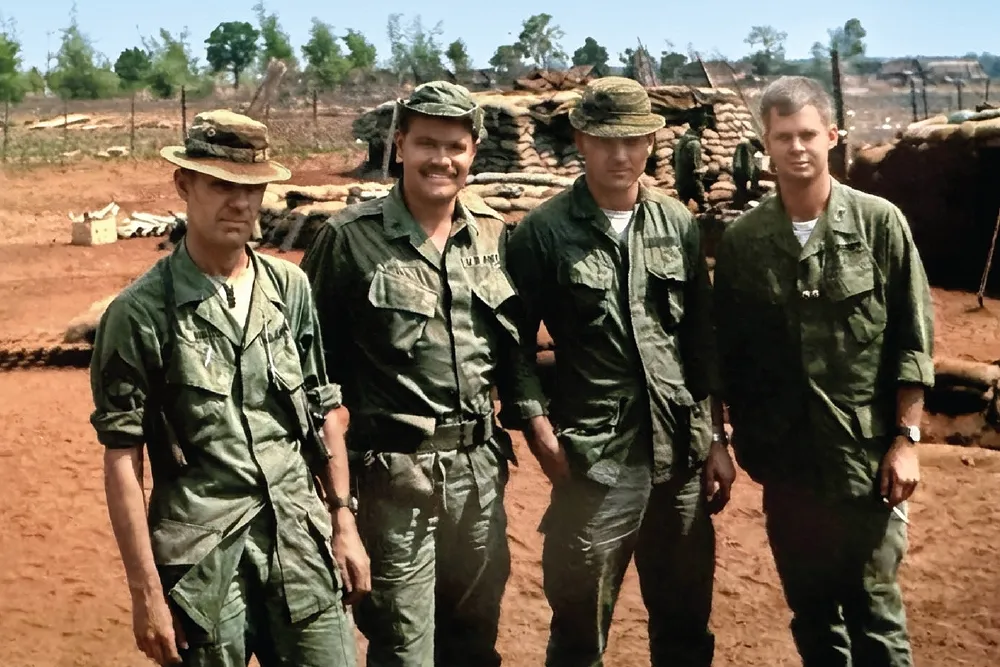
Above: Steffens and fellow soldiers in Pleiku.
He was going to burn it?!
From the first page forward, I realized that this was an astonishing piece of writing, with an excellent chance of being published. “You cannot destroy this!” I fumed. “What if I find a publisher?” He thought for a bit and said, “Would you help me finish it?” I agreed. In early January of 1975 we flew to New York City in a blizzard. I remember carrying him in my arms down the gangplank of the plane. We got an offer from McGraw-Hill. I ended up spending the next eight months working sporadically all over the country with him. Ron was a deeply disturbed, psychologically tortured man who had been paralyzed from the waist down on his second (voluntary) tour in Nam, while still a virgin.
What became of Ron?
After Ron borrowed $2,500 from my wife Mary and me, we all flew to NYC in ’75 to deliver the manuscript. He wanted to then fly me to Paris to take the photo for the book’s jacket. Instead, he disappeared, leaving us stranded and broke. We never saw him again.
“He showed me a stack of paper with typing that went from the very edges top to bottom. He then wheeled his chair over to the fire.”
- Steffens
CHAPTER 4: THE BEAT MAGAZINE, A VOICE FOR RADIO & FREE CANNABIS
You also founded, edited and wrote for the premier reggae magazine, The Beat.
For 28 years I edited the annual Bob Marley Memorial Edition, and wrote a regular column called “Ras RoJah’s Reggae Ramblings.” In 1982, I was hired to be the National Promotions Director for Reggae and African Music for Island Records. Two years later I was asked to create a Reggae Grammy Committee, which I served as chairman of for 27 years. That same year I was invited to show several of the unreleased videos in my ever-growing Reggae Archives at the National Video Festival, which led to my creating a multimedia presentation called “The Life of Bob Marley.”
I toured the world showing it—from the Rock and Roll Hall of Fame to the Grammy Museum to the bottom of the Grand Canyon. I even went to the Outback of Australia, a Polish palace, and a six-date tour of Israel.
You started out wanting to be an actor, right?
It began at five years of age, when my mother would stage plays in Lake Hopatcong, NJ, where we had a summer cabin. I would be Prince Charming and other childhood characters. In 1975, Bill Link, creator of the TV show Columbo, became my mentor and cast me in the movie Rollercoaster. From there on I played a variety of TV and film roles, especially in my dear friend John Ritter’s productions. John and I spent many nights sharing Js.
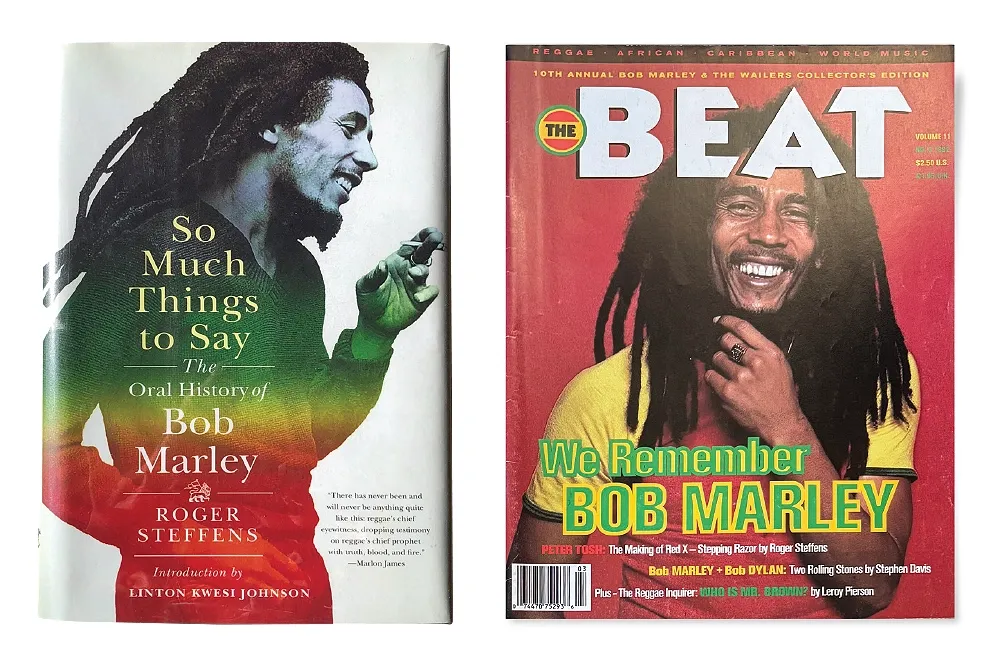
Left: Cover of Steffens’ book, So Much Things to Say: The Oral History of Bob Marley. Right: Cover of The Beat magazine’s annual Bob Marley issue, edited by Steffens.
But it was your silky baritone voice that everyone wanted…
It was my voiceover career that really thrived. I narrated The Flight of the Gossamer Condor, which won an Oscar. In all, I’ve narrated more than 800 films, industrials, and commercials. One of my favorite gigs was playing the announcer in Forrest Gump when Forrest meets John Kennedy and has to pee so badly. I won an Audie Award as co-narrator of Battlefield Earth and was an Audie nominee for reading Bill Gates’ audiobook Business at the Speed of Thought.
Finally, what is your cannabis routine these days?
I like a good strong indica. If I’m going to get stoned, I really want something that will take me to that next level. Most of what I smoke these days is homegrown, either in our spacious backyard with lots of sunlight, or from California growers. I’m fortunate that people who ask to see the Reggae Archives often bring gifts of their favorite strains. I’ve saved a lot of money since legalization!
Rob Hill has written for Ray Gun, Maxim, Playboy, Rolling Stone, LA WEEKLY, Treats!, The Riv, FHM, and mg. He is Co-founder and Editor-in-Chief of Hiii.
Lamb’s Breath
Bob Marley’s Go-To Strain
Bob Marley was known to drive hundreds of miles across the island of Jamaica to get his favorite cannabis: Lamb’s Breath, aka Lamb’s Bread. Although its genetic origins are a mystery, it originated in Jamaica in the late ‘60s where it was the go-to cannabis for the Rastafarians. The name “Lamb’s Bread” is thought to have spiritual and biblical significance, aligning with Rastafarian beliefs. In Rastafari culture, the lamb is often seen as a symbol of purity and righteousness, reflecting the belief that cannabis is a sacred plant that aids meditation, self-reflection, and connection to Jah (God). It is a deliciously pungent, fluffy, head-focused, light green, sativa-dominant hybrid that looks like balls of sheep’s wool.
Effects
Relaxation, motivation, enhanced creativity, laser-sharp focus, increased arousal.
Aroma
Cheesy, sweet, spicy lemon.
THC
16.00%-21.00%
Lamb’s Breath is available at: The Chronic, Erba Sawtelle, and Nela Rd.