
The Sixties: Illegal Ink
The game-changing pot publication that blazed a path for High Times.
Written By: ADAM TSCHORN
When the first issue of High Times magazine hit the street in June 1974, it changed the cannabis media landscape forever. It’s credited with giving a community a voice, capturing a movement in real time, creating a reliable repository for spreading outlaw knowledge, and even providing a monthly snapshot of illicit drug prices around the country.
Today, thanks to a profound shift in the plant’s legal status, it’s almost impossible to imagine the flow of information in the before times. How did the weed heads get their reliable intel? How did they connect and organize? Where did they turn for the straight dope on all things dope?
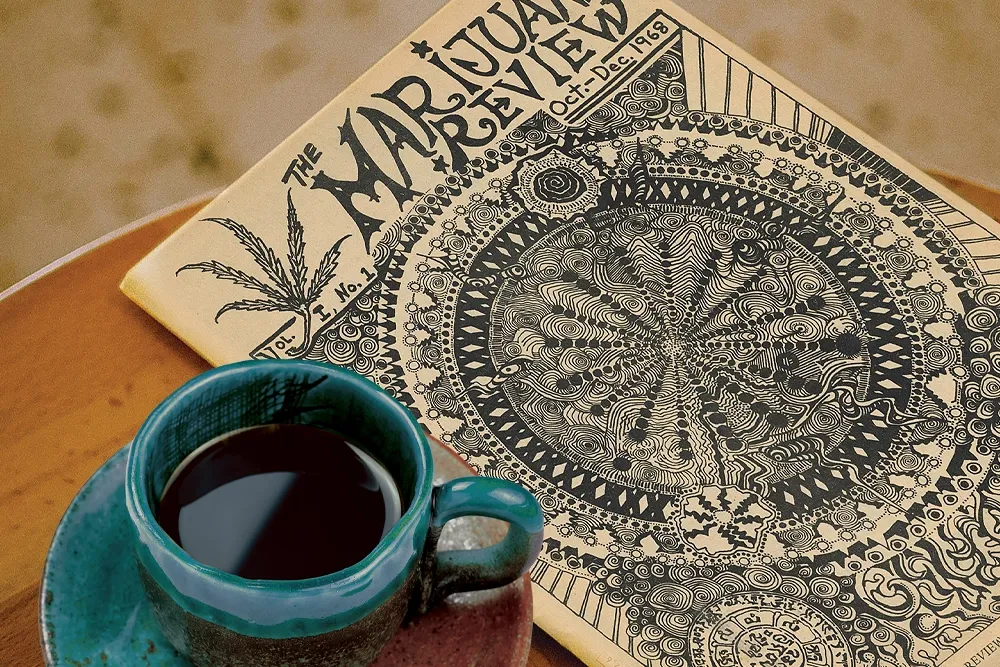
Some of those answers, as well as some firsthand insight into High Times’ early crawl out of the primordial ooze of ideation, fell into my hands recently—literally—in a tiny, second-floor apartment in San Francisco’s Cow Hollow neighborhood. I was there to meet with Michael and Michelle Aldrich, an 80-something couple instrumental in the early push for legalization who had contacted me about working with them on their memoirs. At one point, Michael gingerly handed me a thin ‘zine-style booklet with a swirling hand-drawn psychedelic circle on the cover. Above it was the title The Marijuana Review, dated Oct.-Dec. 1968.
Aldrich explained that he and co-editor Ed Sanders (a fellow activist who also happened to be the lead singer of rock band the Fugs) launched the publication at the State university of New York at Buffalo in 1968, where Aldrich was working toward his PhD, and both men had gotten involved with a group called LeMar (short for Legalize Marijuana, a forerunner of today’s NORML).
And perhaps most notable of all, it planted the seeds of possibility in spite of the serious risk of imprisonment.
“I felt we needed a small journal—what you might call a ‘zine nowadays,” Aldrich said. “One that was dedicated to getting reliable information about cannabis out into the world. Ed Sanders agreed. And since he was involved with the Fugs (who were popular), it meant he didn’t really have to worry about money. I wrote most of the copy and typed it up on an IBM Selectric, which was the newest, really hot typewriter at the time.
Then I’d send the copy to Ed who would take those pages to a printer and pay for it. Then he’d send me hundreds of copies and I’d mail them to our contact lists. With Ed as publisher, I was able to successfully solicit articles from William S. Burroughs and many others.”
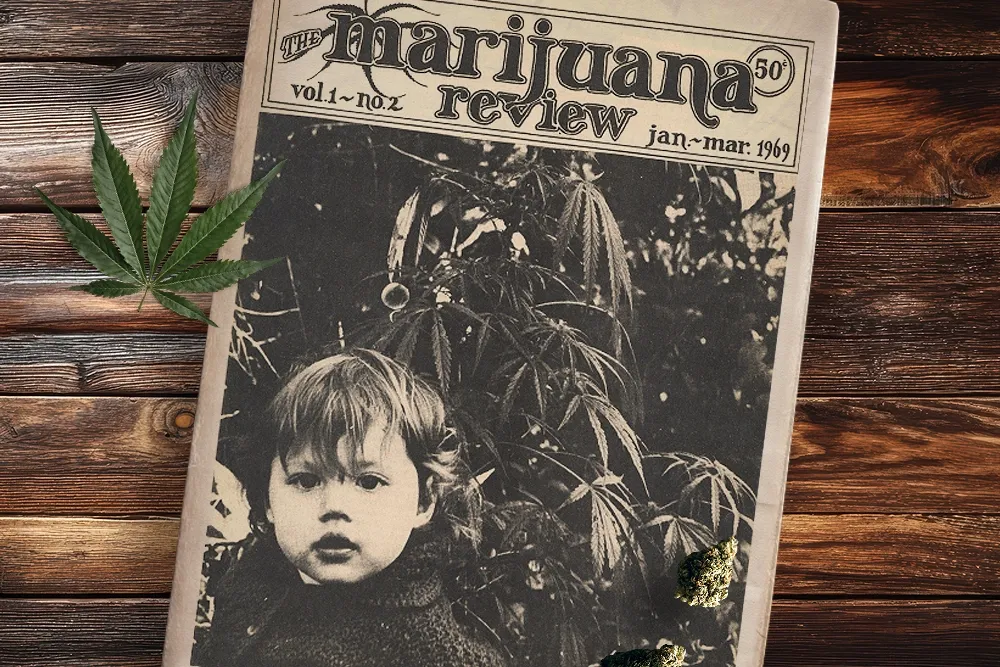
As the house organ of LeMar International, a who’s who of the era’s counter culture crowd ended up splashed across the pages. Beat poet Allen Ginsberg was listed on the magazine’s masthead as a guru (Aldrich was Ginsberg’s assistant for a few years) and a handwritten postcard from him appears in issue three. Author and enthusiastic proponent of LSD, Timothy Leary, turns up frequently; as does White Panther Party co-founder John Sinclair, whose then two-year-old daughter Sunny appears on the cover of issue two, toddling amidst a garden of pot plants.
Aldrich said the goal was for the magazine to serve as a kind of counterweight to the way marijuana was portrayed in the media at the time. “Basically, there was the United Nations Bulletin on Narcotics—essentially the international journal of prohibitionists,” he said, “and the ill-informed crap that ran in Reader’s Digest, all the Hearst newspapers, all the U.S. government publications, and every other newspaper and magazine in circulation at the time.”
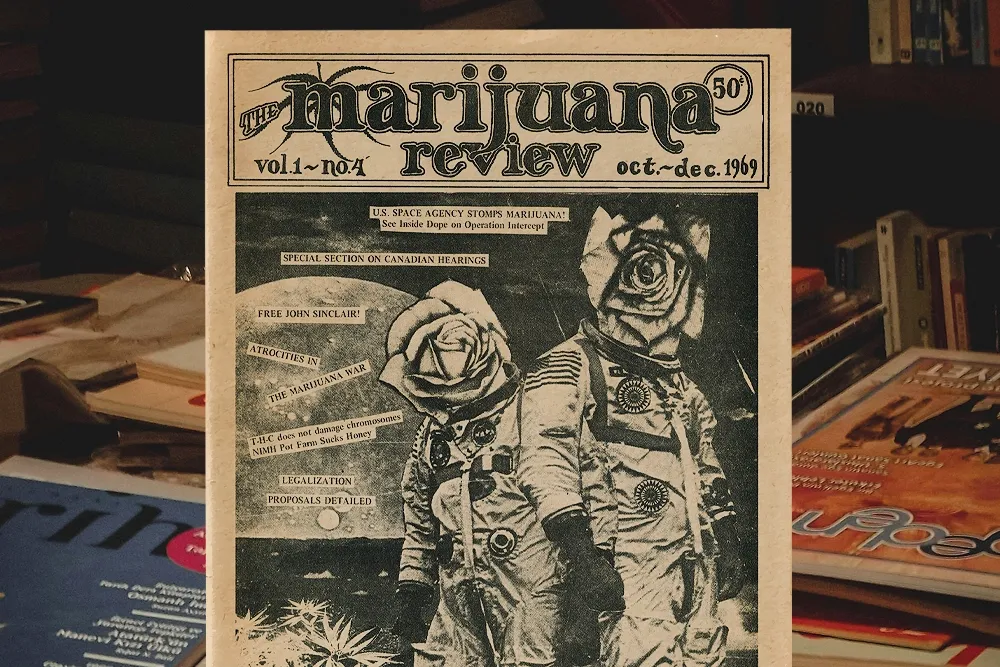
Aldrich and Sanders would publish a total of nine issues in all, eight between October 1968 and October 1971 and a final one in early 1974. Each one served up a mix of news, pro-pot editorials (example: “The new open world is a gigantic smoke-in. Our time is Now.”), DIY tutorials (how to turn a coffee cup into a hookah), recipes (bhang pops), rally and protest notices, and scholarly articles. A recurring feature, the “Gage Price Gauge,” noted the prevailing prices of weed around the country. And perhaps most notable of all, it planted the seeds of possibility in spite of the serious risk of imprisonment.
A riveting account of how U.S. soldiers would occasionally get high with their Viet Cong counterparts.
Read now, more than half a century removed, the pages of The Marijuana Review provide a rare snapshot of what was happening in the movement as it was being lived by the people it was happening to. One of the most mindblowing stories, titled “Marijuana and the Military: A Complete Report,” was published in the debut issue at the height of the Vietnam War. It includes, among other anecdotes of drug use by troops at home and abroad, a riveting account of how U.S. soldiers would occasionally get high with their Viet Cong counterparts.
None of those elements seem particularly novel today, especially for a weed mag. And they might even feel familiar to those who, like me, grew up reading High Times. When I mentioned some of the similarities to Aldrich—especially how High Times’ “Trans-High Market Quotation” column reminded me of The Review’s “Gage Price Gauge”—he laid the following story on me.
“I first met [High Times founder] Tom Forçade long distance because he was the coordinator of the Underground Press Syndicate, which was in charge of distributing all the underground papers across the country,” Aldrich explained, adding that, as a result, Forçade was intimately familiar with what Sanders and Aldrich were doing with The Marijuana Review.
Aldrich said they would eventually meet in person in 1973, when Forçade winged his way to San Francisco with an ask.
“He wanted permission to use the name ‘The Marijuana Review’ for his own new magazine,” Aldrich said. “I thought about it for a minute and then told him, ‘No.’
I knew, even back then, that The Marijuana Review was a classic. It was essentially the first marijuana magazine and it was my special creation, the way Tom’s would be his. He was envisioning a slick, glossy publication and we were publishing something that felt more like an underground tabloid. So I told him to let The Review be what it was. I said, ‘You’ll find a better name.’ And sure enough he did! I think High Times turned out to be the perfect title.”
Although Aldrich didn’t hand over the name, he happily handed over his mailing list, a move that ensured that the first issue of High Times ended up in the hands of the right people right out of the gate. It was, he says, the beginning of a long relationship. “Tom invited me to be on the editorial board, and I accepted, and I wrote a few pieces for them in the early days. I was even listed on the masthead as literary editor for a while.”
That Aldrich and Sanders’ Marijuana Review blazed a trail for High Times—and all pot publications that followed—is just one reason why it’s worth seeking out and flipping through (on-demand reprints are available via Amazon for $4.99 an issue, a full set of originals from a rare book seller will run you $9,500). Another is that it underscores how vitally important it is to preserve the cannabis community’s stories—as told by the cannabis community—for the long haul. We must all work to put them in print, and support those who do. We need to fix them in the amber of in-the-moment clarity, make them tangible, and help them live forever.